What Happens When Sound Stops Being Language
Human beings have always tried to name the infinite.
God. Allah. Yahweh. Ishvara.
Each name carries devotion. Each name carries culture.
But there is a quiet problem hidden inside language.
Every word defines.
And whatever is defined becomes limited.
So how do you name something that has no boundary?
Some traditions did not try to describe the infinite. They tried to sound it.
That sound is OM.
Not as a religious slogan.
Not as decoration.
But as vibration.
Dikshaant
Feb 16, 2026
10
mins
Reading time
The Limits of Language
Language divides reality.
Tree. Sky. Body. Mind. Mine. Yours.
Words help us navigate. But they also fragment.
When you say “rose,” you exclude everything that is not rose.
When you say “God,” you often imagine a form.
But the infinite cannot be captured in a conceptual container.
So instead of inventing another descriptive word, ancient inquiry turned to something more primal.
Sound.
Before language.
Before grammar.
Before theology.
Pure vibration.
Why OM Is Different From a Word
OM is not descriptive. It does not point to something.
It is an unfolding sound.
A… U… M.
Open throat.
Movement forward.
Closure at the lips.
It begins where all sound begins.
It ends where all sound ends.
In that sense, OM contains the full arc of vocal expression.
It is not tied to one culture because it is built into the mechanics of being human.
When a baby cries, the first impulse is open sound.
When speech concludes, the lips close.
Beginning.
Middle.
End.
OM mirrors that entire movement.
Sound and Identity
But why does this matter psychologically?
Because sound bypasses concept.
Most of your stress lives in language.
“I failed.”
“I am behind.”
“I am not enough.”
These are linguistic structures.
When you chant OM slowly, you are not repeating a belief. You are engaging vibration.
And vibration does something thought cannot.
It quiets identity.
Not by suppressing it.
By softening its grip.
The Psychological Effect of Sound
Modern neuroscience observes that slow, resonant chanting can regulate breath and influence the nervous system.
But even without scientific framing, you can test something directly.
Sit quietly.
Take one full breath.
Chant OM slowly.
Notice what happens to your body.
The chest vibrates.
The skull subtly hums.
Breath lengthens.
Attention shifts from narrative to sensation.
And when attention leaves narrative, identity pressure decreases.
The “me” that was worrying about tomorrow pauses.
Not because it was solved.
Because it was not being fed.
OM Beyond Religion
Is OM tied to one tradition?
Historically, it has deep roots in Indian philosophical inquiry. But experientially, it is not confined by belief.
You do not need to convert to use breath.
You do not need a doctrine to experience vibration.
OM functions at the level of physiology and awareness.
It is not a password to heaven.
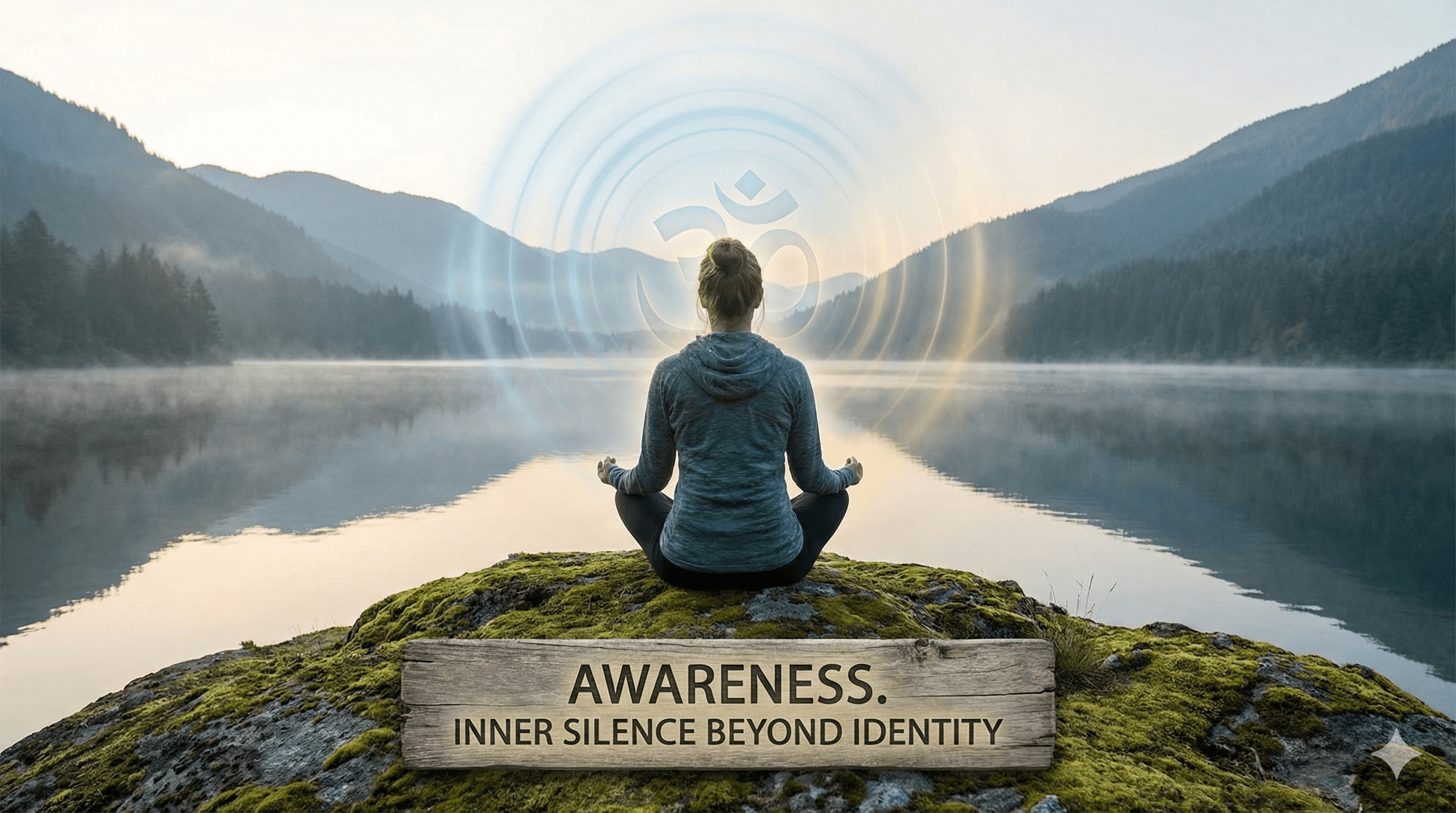
It is a doorway into silence.
Why Silence Matters
The most interesting part of OM is not the sound.
It is what follows.
After the M fades, there is a brief stillness.
No word.
No effort.
That gap is often overlooked.
But that gap reveals something important.
Awareness remains, even when sound ends.
And in that space, identity relaxes.
OM in Relationships and Leadership
This may sound abstract, but it has practical implications.
When identity is constantly active, you react.
When identity softens, you respond.
Practices that reduce internal noise improve clarity.
A leader who can pause before reacting is not weaker.
They are more precise.
A partner who can sit with discomfort before speaking listens more honestly.
If OM reduces psychological reactivity even slightly, its impact extends far beyond meditation.
What OM Is Not
It is not magical thinking.
It is not an instant cure.
It is not a badge of spirituality.
It is a tool.
A simple acoustic movement that brings attention back to direct experience.
And direct experience is quieter than mental storytelling.
Closing Reflection
Tomorrow morning, before checking your phone, try this:
One breath.
One slow OM.
Listen until the sound dissolves.
Notice the silence that remains.
That silence may be closer to what you are than any word you use.