An Invisible Crisis Hidden Behind Laughter
We speak of childhood as golden.
Innocent. Playful. Free.
But if you look carefully, childhood is not freedom. It is vulnerability.
A child does not control their environment.
They do not control their schedule.
They do not control their safety.
They often do not even control their own emotions.
Behind the image of play, there is something fragile.
And often, deeply misunderstood.

Dikshaant
Feb 21, 2026
15
mins
Reading time
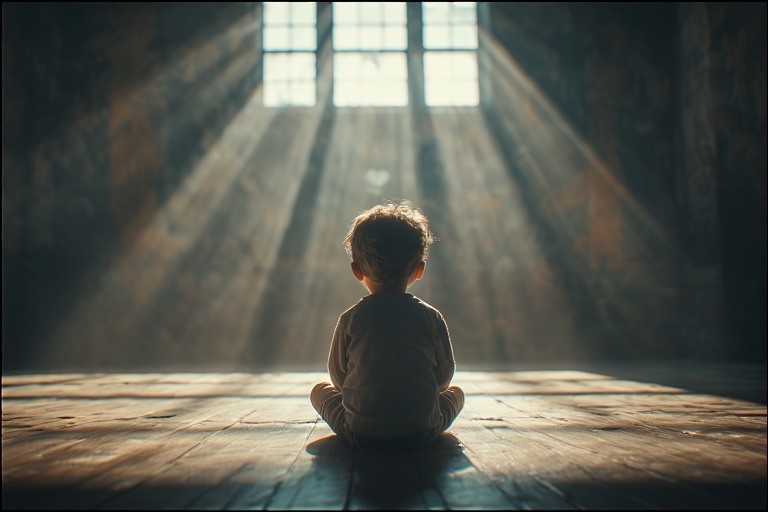
Why Childhood Feels So Powerless
A child lives inside a world designed by others.
Adults decide:
What is right.
What is wrong.
When to speak.
When to stay quiet.
When to study.
When to sleep.
The child adapts.
Sometimes silently.
Sometimes through rebellion.
Sometimes through tears.
But rarely through understanding.
Because understanding is still forming.
The Mind in Early Formation
The mind in childhood is impressionable.
It absorbs tone more than words.
It absorbs reactions more than explanations.
It absorbs fear more than logic.
A harsh comment can linger for years.
A dismissive look can become self-doubt.
Repeated comparison can quietly shape identity.
Children do not have strong psychological boundaries yet.
So everything enters deeply.
Fear as a Constant Companion
Adults often underestimate how much fear exists in childhood.
Fear of punishment.
Fear of rejection.
Fear of not being good enough.
Fear of disappointing parents.
Fear of being laughed at.
And because children lack language for inner complexity, fear appears as:
Irritability.
Tantrums.
Withdrawal.
Defiance.
Behavior becomes the visible surface.
But underneath is confusion.
Emotional Intensity Without Regulation
In adulthood, you may feel anger and still maintain composure.
In childhood, emotion overwhelms.
Hunger feels catastrophic.
Embarrassment feels permanent.
Loneliness feels absolute.
There is little perspective.
Time feels long.
Correction feels humiliation.
Waiting feels endless.
The nervous system is still learning how to settle.
The Illusion of Carefree Years
We remember our childhood selectively.
Moments of play.
Festivals.
Vacations.
But children do not live in memory. They live in immediacy.
And immediacy, without stability, can feel chaotic.
A child depends entirely on adults for interpretation of the world.
If those adults are anxious, distracted, critical, or emotionally unavailable, the child internalizes instability.
Not as theory.
As identity.
The Swings of the Early Mind
The child’s mind moves quickly.
From joy to tears.
From attachment to anger.
From curiosity to fear.
It resembles emotional weather more than stable climate.
Without guidance, these swings become patterns.
And those patterns often carry into adulthood.
Many adult anxieties are not new.
They are extended versions of unresolved childhood confusion.
Authority and Shame
School environments can amplify vulnerability.
Evaluation.
Comparison.
Discipline.
Some children thrive.
Others quietly shrink.
A child who is repeatedly corrected without being understood may grow compliant outwardly but conflicted inwardly.
The wound is not the correction.
It is the absence of explanation and safety.
Desire Without Understanding
Children want intensely.
Attention.
Toys.
Approval.
Belonging.
When desires are unmet, frustration feels absolute.
But because reasoning is immature, the mind cannot contextualize disappointment.
So it reacts dramatically.
This is not weakness.
It is developmental reality.
Why This Matters in Adulthood
Unprocessed childhood experiences do not disappear.
They evolve.
Fear becomes perfectionism.
Rejection becomes withdrawal.
Criticism becomes inner harshness.
Instability becomes chronic anxiety.
Many adults are managing childhood emotions with adult language.
Without recognizing the origin.
Is Childhood Only Suffering?
No.
It is also the foundation.
It is where sensitivity develops.
Where curiosity begins.
Where identity takes shape.
But without awareness and support, that foundation can be unstable.
Childhood is not inherently tragic.
It is powerful.
Which means it can shape strength or fragility.
The Role of Guidance
A stable adult presence changes everything.
Not perfection.
Not strictness alone.
Not indulgence.
But attuned presence.
Listening.
Explaining.
Validating.
Setting boundaries calmly.
Children do not need constant control.
They need psychological safety.
For Parents
Pause before reacting.
Ask:
Is this behavior confusion?
Is this fear?
Is this exhaustion?
Children rarely misbehave without internal turbulence.
Correct behavior.
But understand emotion.
That difference builds trust.
For Adults Reflecting on Their Own Childhood
Instead of blaming or dramatizing, inquire.
What did I feel often?
Fear? Pressure? Comparison? Loneliness?
What beliefs formed then?
“I am not enough.”
“I must prove myself.”
“I am alone.”
Seeing these origins reduces self-judgment.
It replaces shame with clarity.
Closing Reflection
Think about a child you know.
Or think about yourself at seven years old.
Small. Dependent. Watching adults for cues.
Now ask gently:
What did that child need most?
Often the answer is not discipline.
Not achievement.
Not perfection.
It is understanding.
When childhood is understood, adulthood becomes lighter.
When it is ignored, it echoes.